
The scale can't tell
muscle from fat.
The InBody 270 can. Sixty seconds, standing up, fully clothed, and you leave knowing your fat mass, your lean muscle, and how it is distributed. $50 a scan, or included at every visit on a Summit Health plan.

Two people, same weight, completely different bodies
Your bathroom scale gives you one number and no context. BMI adds height and still cannot see inside you.
You lost 15 pounds. Of what?
If a third of it was muscle, your metabolism is now slower and the weight comes back easier. The scale showed you a win either way.
The scale hasn't moved in a month
People quit here. Sometimes fat is down and muscle is up and the number just sat still, which is a good month misread as a failure.
You're "overweight" by BMI
The CDC's own guidance says people with a lot of muscle can land in the overweight or obesity category on BMI alone.
What the CDC actually says about BMI
"BMI cannot distinguish fat mass from lean body mass (muscle and bone)." It is a fast screening tool, not a measurement of your body. That is the gap this scan closes.
How well does it actually measure?
test-retest reliability (ICC) for percent body fat on repeat multi-frequency BIA scans.
Frontiers in Nutrition, 2024. Sourceis the typical difference between two scans taken on the same day.
Frontiers in Nutrition, 2024. Sourcecorrelation between InBody 270 values and DXA, the reference scan.
PLOS ONE, InBody 270 validation. Sourceof total weight lost on semaglutide was lean mass across reviewed trials.
Systematic review, PubMed 38629387. SourceThat last number is the one to sit with if you are on a GLP-1. The range is enormous because outcomes vary enormously, and the only way to know which end you are on is to measure it while there is still time to change it.
Straight answer: it repeats extremely well, and it reads a little differently than a DXA
Those are two different questions and they get confused constantly. Here is how the InBody 270 and multi-frequency BIA perform on each.
Repeatability: excellent
This is the property that matters for tracking, and it is where BIA is genuinely strong.
- ICC ≥ 0.998 for percent body fat on repeat scans
- ICC ≥ 0.999 for fat-free mass index
- ICC 0.973 to 1.000 for regional, limb-by-limb measures
- Same-day repeat scans differ by 0.0 to 0.2 kg
- Between-day differences 0.1 to 0.7 kg
An ICC above 0.99 means that if we scan you twice, the machine tells you very nearly the same thing both times. That is what makes a trend line meaningful.
Absolute accuracy: close, with an offset
Measured against DXA, the research-grade reference, BIA tends to read body fat slightly low.
- Correlation with DXA of r = 0.97 to 0.99
- Body fat percentage bias of about −4.0% versus DXA
- Fat mass bias of about −2.9 kg
- In trained adults, one study found no statistically significant difference between InBody 270 and DXA on any measure
So your number may sit a few points below what a DXA would report. The offset is consistent, which is exactly why the change between your scans stays trustworthy.
What this means for you, practically
Do not treat one scan as the absolute truth about your body. Do treat the difference between scan one and scan four as real. A device that repeats to within 0.2 kg and that you can afford to run every month will tell you more about your actual progress than a single precise measurement you never repeat.
Figures above are from peer-reviewed validation research on multi-frequency bioelectrical impedance and on the InBody 270 specifically, linked in the section above. Study populations and protocols differ; your individual results will vary.
What the InBody 270 measures
You leave with a printed result sheet, and your provider walks you through it rather than handing it over at the door.
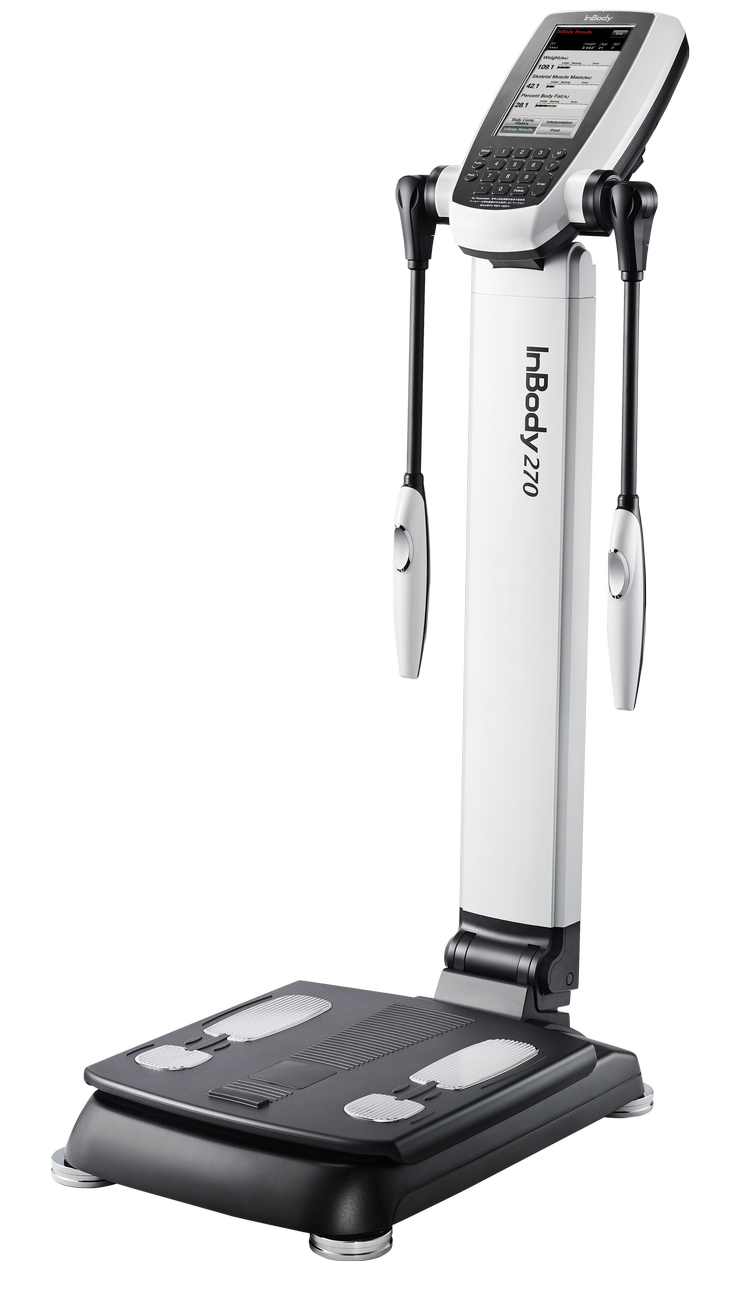
The InBody 270
A dual-frequency, eight-point tactile electrode analyzer. It measures at 20 kHz and 100 kHz and reads each limb and the trunk separately rather than treating you as one whole-body average. Sixty seconds, standing, fully clothed.
Mass and composition
- Fat mass and fat-free mass, separated
- Body fat percentage
- Skeletal muscle mass
- Segmental muscle distribution, limb by limb and trunk
Water and metabolism
- Total body water
- Intracellular and extracellular water
- Basal metabolic rate, your resting energy expenditure
- A baseline you can compare against at every follow-up
Segmental data is the part people underrate. Knowing that your right leg carries noticeably less muscle than your left, or that your trunk lags your limbs, is actionable in a way a single body fat percentage is not, and those regional measures repeat at an ICC of 0.973 to 1.000.
You do not have to be our patient
The scanner is open to the public at $50. Plenty of people use it who get their care somewhere else entirely.
Anyone on a GLP-1
Whether we prescribed it or not. If you are losing weight on semaglutide or tirzepatide, knowing how much of it is muscle changes what you should be eating and lifting.
Athletes and lifters
Tracking a bulk, a cut, or a season. Segmental muscle data shows imbalances that a mirror and a scale both miss.
Anyone starting a program
A baseline before week one is worth more than any measurement taken later, because it is the only one you cannot go back and get.
People whose labs are fine
Normal bloodwork and a body that does not feel right. Composition sometimes explains the gap.
Anyone over 40
Muscle mass declines with age quietly. A number now gives you something to defend later.
Teams and groups
Call us about scanning a group. Sports teams, gyms, and workplace groups can be arranged outside normal appointment slots.
What the scan is actually like
Shoes and socks off
That is the whole preparation. You stay fully clothed. Nothing is submerged, nothing is pinched with calipers, and there is no changing room involved.
Stand on the platform, hold the handles
The InBody 270 sends a small, painless electrical current through your body and measures the resistance different tissues offer. Muscle holds water and conducts easily. Fat does not.
Sixty seconds
You stand still and it runs. Most people are surprised at how quick it is compared to what they expected.
Your provider reads it with you
A results sheet nobody explains is just paper. We go through what each number means for you and what would move it.
For consistency, try to scan under similar conditions each time: similar hydration, similar time of day, and not straight after a hard workout or a large meal. Bioelectrical impedance is sensitive to hydration, and comparing like with like is what makes the trend meaningful.
Fifty dollars, or free with a plan
- Full InBody 270 analysis
- Printed results sheet
- Provider walkthrough of your numbers
- No membership, no program required
- Scanned at your initial evaluation
- Repeated at every follow-up visit
- Tracked against your labs over time
- Used to adjust your protocol, not just filed
That second column applies across medical weight loss, testosterone therapy, bioidentical hormone therapy, and peptide therapy. HSA and FSA friendly.
How to make the trend line mean something
Bioelectrical impedance is sensitive to hydration. That is not a flaw you have to accept blindly, it is a variable you can control, and controlling it is what turns a series of scans into usable data.
Scan under similar conditions
Similar time of day, similar hydration, not straight after a hard workout or a large meal. Consistency between scans matters more than any single scan being perfect.
Watch the direction, not the decimal
A 0.3 kg wobble between two scans is inside normal between-day variation. Three consecutive scans moving the same way is a trend.
Monthly beats occasional
The value of a cheap, repeatable scan is that you can run it every month. Twelve data points in a year beat one very precise measurement you never repeat.
Pair it with your labs
Composition plus bloodwork answers questions neither one can alone, which is why both are included on our treatment plans.
Segmental data catches imbalance
Limb-by-limb muscle measures repeat at ICC 0.973 to 1.000, so a persistent left-right difference is signal rather than noise.
Bring old results
Scanned somewhere else before? Bring the printout. Comparing across devices is imperfect, but it still adds context.
What this scan is and isn't
The InBody 270 uses bioelectrical impedance analysis. It is fast, highly repeatable, and far more informative than a scale or BMI. It is not a DXA scan, and it should not be read as one.
Readings shift with hydration, recent food, and recent exercise, which is why we weight your trend across repeated scans more heavily than any single absolute number. Validation research also shows a systematic offset against DXA, typically reading body fat percentage a few points lower.
Body composition analysis is not a diagnostic test and does not replace medical evaluation or laboratory work. It is one input among several. Devices using bioelectrical impedance are generally not recommended for people with an implanted pacemaker or defibrillator, so tell us if that applies to you.
Individual results vary. Body composition analysis is a screening and tracking tool, not a diagnosis.
Scott Adler, PA-C
Scott reads your results with you and connects them to whatever else is going on, whether that is a weight loss protocol, a hormone panel, or just a question about why the scale stopped moving. Patients in 54 five-star Google reviews describe him as thorough and quick to answer.
★ 5.0 out of 5
Across 54 Google reviews, with owner responses on nearly all of them.
Locally owned
One clinic, at 2833 E Battlefield Rd in Springfield, serving southwest Missouri.
Open to non-patients
You can scan here and keep your care wherever it already is. That is fine with us.
Common questions about body composition analysis
What is InBody 270 body composition analysis?
The InBody 270 is a medical body composition analyzer that measures fat mass, fat-free mass, body fat percentage, skeletal muscle mass and its segmental distribution, total body water including intracellular and extracellular water, and basal metabolic rate. At Summit Health Clinic in Springfield, Missouri a scan costs $50, takes about sixty seconds, and is included at every visit for patients on a treatment plan.
How much does a body composition scan cost in Springfield, MO?
$50 per scan at Summit Health Clinic if you are not on one of our treatment plans. If you are a weight loss, testosterone, hormone, or peptide therapy patient, scans are included at your initial evaluation and at every follow-up visit at no additional charge.
Do I need to be a patient to get scanned?
No. The scanner is open to the public. Athletes, gym members, and people getting their medical care elsewhere use it regularly, including people on GLP-1 medications prescribed by another clinic.
How accurate is the InBody 270 compared to a DXA scan?
Validation research reports correlations of r = 0.97 to 0.99 between InBody 270 values and DXA. There is a systematic offset: multi-frequency BIA tends to read body fat percentage about 4 percentage points lower than DXA, and fat mass about 2.9 kg lower. One study in exercise-trained adults found no statistically significant difference between the InBody 270 and DXA on any body composition measure. Practically, treat your number as slightly conservative against a DXA, and treat the change between your own scans as reliable.
How repeatable is it? Can I trust a change between scans?
Repeatability is the strongest property of this device. Published test-retest reliability for multi-frequency BIA is an intraclass correlation of 0.998 or higher for percent body fat and 0.999 or higher for fat-free mass index, with same-day repeat scans differing by only 0.0 to 0.2 kg and between-day scans by 0.1 to 0.7 kg. That means a change larger than roughly a kilogram across scans taken under similar conditions is very likely a real change rather than measurement noise.
Why does hydration matter so much?
Bioelectrical impedance works by measuring how easily a small current passes through your tissue, and muscle conducts well because it holds water while fat does not. That makes the reading sensitive to how hydrated you are. It is why we ask you to scan under similar conditions each time: similar time of day, normally hydrated, not straight after a hard workout or a large meal.
How do I prepare?
Take off your shoes and socks. That is genuinely it. For the most comparable results across scans, aim for similar conditions each time: normally hydrated, not immediately after a heavy meal, and not straight after a hard workout.
How long does it take?
The scan itself runs about sixty seconds. You stand on the platform holding two handles, fully clothed. Add a few minutes for your provider to go through the results with you.
Is it accurate?
The InBody 270 uses bioelectrical impedance analysis, which is fast, repeatable, and much more informative than a scale or BMI. It is not equivalent to a DEXA scan. Readings shift somewhat with hydration and recent meals, so we weight the trend across repeated scans more heavily than any single absolute number.
Is it safe? Does it hurt?
It is painless. The device passes a very small electrical current through your body, which most people do not feel at all. Bioelectrical impedance devices are generally not recommended for people with an implanted pacemaker or defibrillator, so let us know if that applies to you.
Why does this matter if I am on a GLP-1?
Because not all weight lost is fat. A systematic review of semaglutide trials found lean mass reductions ranging from almost zero to 40% of total weight lost, depending on the study. Losing a large share of muscle slows your metabolism and makes regain easier. Scanning monthly tells you which of those outcomes you are having while there is still time to change it.
Can you scan a team or a group?
Yes. Call us to arrange it. Sports teams, gyms, and workplace groups can be scheduled outside normal appointment slots.
Where our patients come from
Body composition scans are done in the Springfield office. Most of our patients drive in from these communities:
2833 E Battlefield Rd, Bldg B, Ste 100, Springfield, MO 65804. Call or text (417) 232-3000.
Find out what you're actually made of
Sixty seconds, $50, and a number you can actually work with.
Related: medical weight loss, testosterone therapy, women's hormone therapy.
This page is for informational purposes only and does not constitute medical advice. Body composition analysis is a screening and tracking tool and is not a diagnostic test; it does not replace medical evaluation or laboratory work. Individual results vary. Bioelectrical impedance devices are generally not recommended for individuals with implanted pacemakers or defibrillators. Consult your healthcare provider about what your results mean for you.